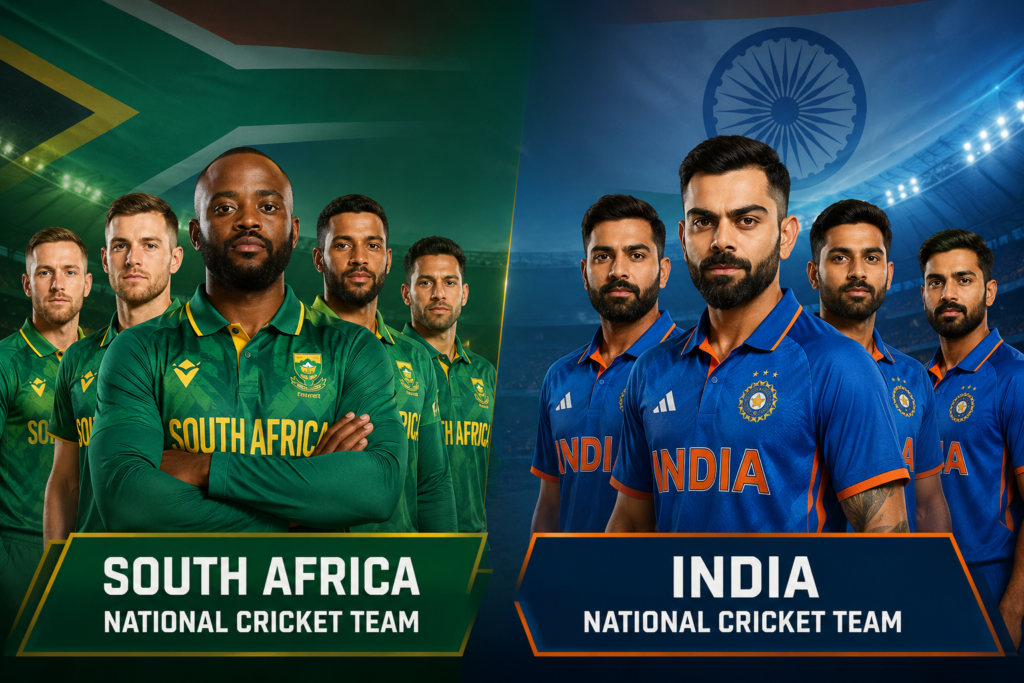
The south africa national cricket team vs india national cricket team timeline tells the story of one of modern cricket’s most competitive and respected rivalries. Unlike traditional rivalries fueled by politics or geography, India and South Africa have built their cricketing relationship on mutual admiration, world-class talent, and unforgettable contests across formats.
Since South Africa’s return to international cricket in the early 1990s, meetings between the two sides have consistently produced high-quality cricket. From Sachin Tendulkar’s masterclasses to Jacques Kallis’ dominance, from AB de Villiers’ brilliance to Virat Kohli’s leadership era, this rivalry has evolved with every generation. The timeline is filled with dramatic Test battles, World Cup encounters, and record-breaking performances that have shaped international cricket for more than three decades.
The Beginning of the Rivalry After South Africa’s Readmission
South Africa’s return to international cricket in 1991 marked the beginning of a new chapter in world cricket. India became one of the first major teams to face the Proteas following their readmission.
The early encounters carried historical significance beyond cricket. South Africa was rebuilding its international reputation, while India was entering a transformative era led by emerging stars. Their first meetings immediately demonstrated contrasting styles. South Africa relied on pace, athleticism, and disciplined bowling, while India traditionally depended on spin and batting depth.
The early 1990s established many themes that would continue throughout the rivalry. Matches were fiercely contested but played in a spirit of respect. Neither team enjoyed prolonged dominance because home conditions heavily influenced results.
The significance of these initial encounters cannot be overstated. They laid the foundation for what would become one of cricket’s most balanced rivalries, producing legendary players and memorable contests across every format.
Early Milestones
| Year | Event | Significance |
| 1991 | South Africa returned to international cricket | Revival of Proteas cricket |
| 1991-92 | India faced South Africa in early bilateral contests | Beginning of rivalry |
| 1992 | First World Cup meeting | Global stage encounter |
| 1992 | First Test series after readmission period | Established competitive balance |
| 1993 | Regular bilateral cricket began | Rivalry strengthened |
These milestones transformed occasional encounters into a long-term cricket relationship that continues to grow.
South Africa National Cricket Team vs India National Cricket Team Timeline: Key Historical Moments
A closer look at the south africa national cricket team vs india national cricket team timeline reveals several defining periods.
Major Timeline Highlights
| Period | Defining Feature |
| 1991–1996 | Formation of rivalry |
| 1997–2003 | Emergence of global stars |
| 2004–2011 | Competitive balance across formats |
| 2012–2018 | Peak era of elite batting |
| 2019–Present | New generation rivalry |
Each phase introduced new heroes and memorable contests.
The late 1990s witnessed the rise of Sachin Tendulkar, Allan Donald, Shaun Pollock, and Jacques Kallis. Their performances elevated the rivalry beyond bilateral cricket.
During the 2000s, both teams became consistent contenders in ICC tournaments. This period saw increased competitiveness in away conditions and several closely fought series.
The modern era has featured Virat Kohli, Rohit Sharma, Kagiso Rabada, Quinton de Kock, Jasprit Bumrah, and Temba Bavuma, ensuring that the rivalry remains relevant and exciting.
Test Cricket Battles That Defined Generations
Test cricket has often provided the most compelling chapters in this rivalry.
South Africa traditionally enjoyed a significant advantage at home due to fast and bouncy pitches. Indian teams frequently struggled against high-quality pace attacks featuring Allan Donald, Makhaya Ntini, Dale Steyn, Morne Morkel, and Kagiso Rabada.
However, India’s progress overseas gradually narrowed the gap. Improved fast bowling resources allowed India to challenge South Africa more consistently than ever before.
Notable Test Series
| Series | Result | Key Story |
| 1996-97 | South Africa won | Dominant pace bowling |
| 2006-07 | India won Test in SA | Historic breakthrough |
| 2010-11 | Drawn series | Peak competitiveness |
| 2013-14 | Closely fought | Kohli announced himself |
| 2021-22 | South Africa won | New generation battle |
One of the most significant moments came when India secured its first-ever Test victory on South African soil. That breakthrough changed perceptions about India’s overseas capabilities.
The 2010-11 series remains among the finest contests between the two nations, showcasing elite bowling and world-class batting performances.
ODI Rivalry: World Cups, Records and Memorable Chases
If Test cricket built respect, One-Day Internationals brought global attention.
India and South Africa have frequently entered tournaments as favorites, making their encounters particularly important.
South Africa’s athletic fielding revolutionized ODI cricket during the 1990s, while India developed into a batting powerhouse.
ODI Rivalry Snapshot
| Category | India | South Africa |
| Strength | Batting depth | Fast bowling |
| Traditional Advantage | Spin | Pace |
| Home Dominance | Strong | Strong |
| World Cup Meetings | Several classics | Several classics |
| Modern Edge | Balanced squad | Balanced squad |
The 2015 World Cup meeting stands out as a landmark occasion. India produced a commanding performance that demonstrated their evolution into a complete ODI side.
ODI encounters between these teams often feature tactical battles between India’s batting line-up and South Africa’s pace attack. This contrast has consistently delivered entertaining cricket.
Legendary Players Who Shaped the Contest
Every great rivalry is defined by iconic performers.
Batting Legends
| India | South Africa |
| Sachin Tendulkar | Jacques Kallis |
| Rahul Dravid | AB de Villiers |
| Sourav Ganguly | Graeme Smith |
| Virat Kohli | Hashim Amla |
| Rohit Sharma | Quinton de Kock |
Bowling Legends
| India | South Africa |
| Anil Kumble | Allan Donald |
| Zaheer Khan | Shaun Pollock |
| Harbhajan Singh | Dale Steyn |
| Mohammed Shami | Morne Morkel |
| Jasprit Bumrah | Kagiso Rabada |
Sachin Tendulkar’s centuries against South Africa often came against some of the strongest pace attacks in cricket history. Similarly, Jacques Kallis consistently delivered match-winning performances against India.
AB de Villiers brought innovation and unpredictability, while Virat Kohli’s intensity added a new dimension to the rivalry during the 2010s.
Memorable Individual Performances That Changed Matches
Certain performances transcend scorecards and become part of cricket folklore.
Sachin Tendulkar’s innings against world-class South African bowling attacks demonstrated technical excellence under pressure.
Virat Kohli’s centuries in challenging South African conditions showcased his adaptability and determination.
For South Africa, Jacques Kallis repeatedly delivered with both bat and ball. Few players influenced India-South Africa contests more consistently.
AB de Villiers also produced several breathtaking innings that changed the course of matches within a few overs.
Historic Individual Displays
| Player | Performance Type | Impact |
| Sachin Tendulkar | Match-winning centuries | Defined an era |
| Jacques Kallis | All-round excellence | Consistent dominance |
| AB de Villiers | Explosive batting | Changed momentum |
| Virat Kohli | Overseas centuries | Modern benchmark |
| Dale Steyn | Fast bowling spells | Match-winning impact |
These performances elevated ordinary matches into unforgettable sporting spectacles.
ICC Tournament Encounters and Their Significance
World Cups and ICC events have added another layer to the rivalry.
Unlike bilateral series, tournament matches carry knockout implications and global attention.
India and South Africa have met in several major ICC competitions, often entering as top-ranked teams.
Important ICC Encounters
| Tournament | Importance |
| 1992 World Cup | Early rivalry chapter |
| 1999 World Cup | Rising competitiveness |
| 2011 World Cup | High-pressure contest |
| 2015 World Cup | India statement victory |
| 2023 World Cup | Modern rivalry showcase |
These matches frequently influence tournament momentum. A victory between two elite teams often boosts confidence for the remainder of the competition.
The global audience associated with ICC tournaments has helped expand the rivalry’s popularity beyond traditional cricket markets.
How Conditions Influenced Results Across Eras
One fascinating aspect of this rivalry is the influence of playing conditions.
South African pitches generally reward pace, bounce, and seam movement. Indian pitches traditionally favor spin bowling and batting endurance.
This contrast created a unique challenge for visiting teams.
Home Conditions Comparison
| Factor | India | South Africa |
| Pace Assistance | Moderate | High |
| Spin Assistance | High | Moderate |
| Bounce | Variable | Consistent |
| Reverse Swing | Common | Occasional |
| Batting Conditions | Long innings possible | More challenging |
Historically, home advantage played a major role in determining outcomes. However, modern teams have adapted better than previous generations.
India’s development of a quality pace attack and South Africa’s improved spin resources reduced the impact of traditional weaknesses.
The Virat Kohli Era and the Modern Transformation
The arrival of Virat Kohli as captain marked a significant shift in India’s approach.
Indian teams became more aggressive overseas and increasingly capable of competing in fast-bowling conditions.
South Africa simultaneously entered a transition period after the retirement of legends such as Graeme Smith, Jacques Kallis, and AB de Villiers.
Yet the rivalry remained compelling.
Kohli’s leadership emphasized fitness, intensity, and pace bowling depth. Players like Bumrah, Shami, and Siraj gave India the ability to challenge South Africa in its own backyard.
Meanwhile, South Africa rebuilt around talents such as Rabada, Bavuma, and de Kock.
The result was a modern rivalry less dependent on conditions and more focused on overall team quality.
Records and Statistics That Define the Rivalry
Statistics provide a useful lens for understanding the rivalry’s evolution.
Key Rivalry Records
| Record Category | Notable Achievement |
| Most Runs | Multiple legends exceed 2,000 runs |
| Most Wickets | Pace bowlers dominate |
| Highest Team Totals | Both teams crossed 400+ in ODIs |
| Most Centuries | Tendulkar, Kohli, Kallis among leaders |
| Best Bowling Figures | Fast bowlers feature prominently |
What makes these records meaningful is the quality of opposition. Runs scored against South Africa’s pace attacks or wickets taken against India’s batting depth often carry greater significance than similar achievements elsewhere.
The numbers tell a story of balance. Few rivalries feature so many world-class performers succeeding against elite opposition.
Why This Rivalry Remains Important in Modern Cricket
Many historic rivalries fade over time, but India versus South Africa continues to evolve.
Several factors explain its enduring relevance:
- Consistent production of world-class players.
- Competitive matches across formats.
- Strong cricket cultures in both nations.
- Regular ICC tournament meetings.
- Mutual respect between teams.
Unlike rivalries dominated by one side, India and South Africa have experienced periods of success and disappointment. This unpredictability keeps contests engaging for fans.
The rivalry also reflects broader changes in cricket. The growth of analytics, fitness standards, franchise leagues, and multi-format specialization can all be observed through the evolution of these two teams.
As younger stars emerge, new chapters will continue to be added to this remarkable cricket story.
Conclusion
The south africa national cricket team vs india national cricket team timeline is far more than a collection of scorecards and statistics. It is a narrative of cricketing excellence, adaptation, and mutual respect spanning more than three decades. From South Africa’s return to international cricket in the early 1990s to the modern battles featuring elite fast bowlers and dynamic batters, the rivalry has consistently delivered memorable moments. Whether in Test matches, ODIs, or ICC tournaments, both nations have contributed to some of cricket’s finest contests. As future generations take center stage, the south africa national cricket team vs india national cricket team timeline will continue to grow as one of the sport’s most respected and competitive rivalries.
FAQs
What was the first major series in the South Africa vs India rivalry?
The rivalry began shortly after South Africa returned to international cricket in 1991. Early bilateral contests and World Cup meetings established the foundation for future competition. These matches were historically significant because they marked South Africa’s re-entry into global cricket and introduced a rivalry that would become one of the most balanced in the sport. The early encounters also highlighted contrasting cricket philosophies, with South Africa emphasizing pace bowling and India relying on batting depth and spin.
Which format has produced the most memorable India vs South Africa matches?
Both Test and ODI cricket have produced unforgettable contests. Test matches often showcase technical excellence and strategic battles over several days, while ODIs provide dramatic chases and tournament-defining moments. Many cricket historians argue that the greatest India-South Africa encounters have occurred in Test cricket because both teams have fielded world-class bowlers and batters across multiple generations.
Who has been the most influential player in this rivalry?
Several players have strong claims, including Sachin Tendulkar, Jacques Kallis, Virat Kohli, and AB de Villiers. Tendulkar scored crucial runs against elite South African bowling attacks, while Kallis consistently delivered all-round performances. Kohli elevated India’s competitiveness overseas, and de Villiers produced game-changing innings that altered matches within a few overs. Their influence extends beyond statistics because they helped define entire eras of the rivalry.
Why is South Africa considered a difficult place for India to tour?
South African conditions traditionally favor fast bowlers due to pace, bounce, and seam movement. Historically, Indian teams struggled to adapt to these challenges. However, modern Indian squads have improved significantly because of stronger pace-bowling resources and enhanced fitness standards. Victories and competitive performances in South Africa are often viewed as benchmarks of a team’s overseas strength.
What makes this rivalry different from other cricket rivalries?
Unlike rivalries driven primarily by political or geographical factors, India versus South Africa is built largely on cricketing excellence. The competition is characterized by mutual respect, professional conduct, and consistently high-quality performances. Fans appreciate the rivalry because matches usually feature world-class players and tactical contests rather than external narratives.
Which ICC tournament match between India and South Africa was most significant?
Several encounters stand out, but the 2015 Cricket World Cup meeting remains particularly significant. India delivered a commanding performance against a highly rated South African side, reinforcing their credentials as tournament contenders. The match demonstrated India’s growing ability to handle pressure against elite opposition on major stages.
How has the rivalry evolved in the modern era?
The modern era has seen a reduction in traditional home advantages. India now possesses a formidable pace attack capable of succeeding overseas, while South Africa has developed more balanced squads. Advances in coaching, fitness, analytics, and player development have made contests more evenly matched. The rivalry continues to evolve as new stars emerge and both teams adapt to the changing demands of international cricket.