Table of Contents
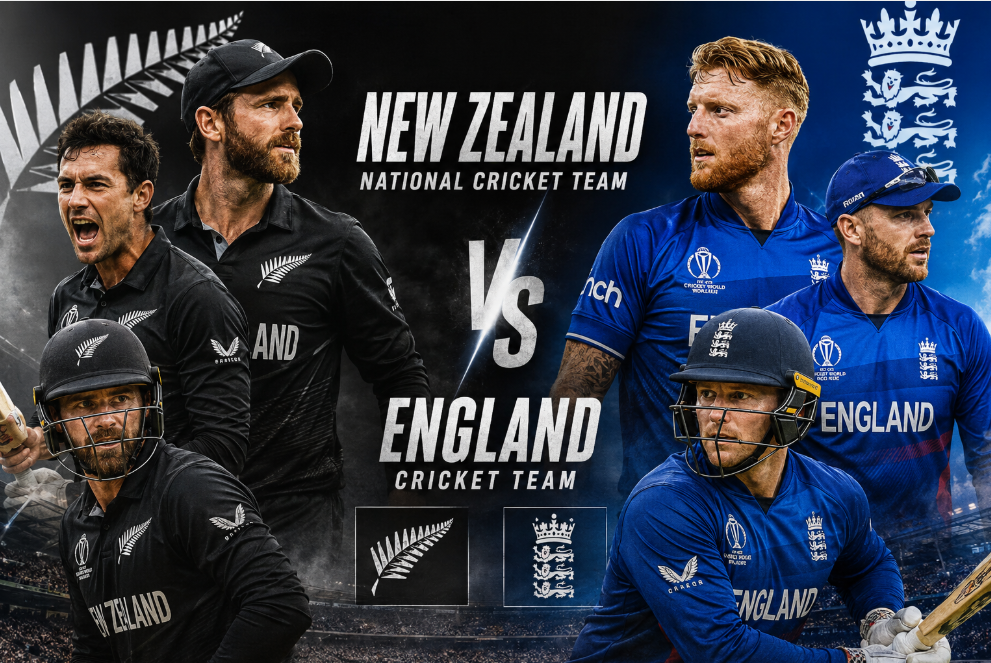
The rivalry between New Zealand and England in international cricket has grown into one of the most intriguing modern contests shaped by contrasting styles, shifting dominance, and unforgettable match moments. From England’s early control built on technical superiority to New Zealand’s rise as a disciplined and tactically sharp unit, the journey reflects how cricket evolves across generations. Every encounter between these two teams carries intensity, whether in Tests, ODIs, or T20s, with momentum often swinging dramatically. Players like Kane Williamson, Joe Root, Trent Boult, and Ben Stokes have added new layers to this rivalry, making it a battle of patience versus aggression, strategy versus power, and tradition versus modern innovation.
Recent Teams & Squads
| Country | Key Batters & Wicketkeepers | All-Rounders & Spinners | Pace Bowlers |
|---|---|---|---|
| England | Harry Brook, Ben Duckett, Emilio Gay, James Rew, Jamie Smith, Jordan Cox | Ben Stokes, Joe Root, Jacob Bethell, Rehan Ahmed, Shoaib Bashir | Jofra Archer, Josh Tongue, Sonny Baker, Matthew Fisher, Ollie Robinson, Gus Atkinson |
| New Zealand | Tom Latham, Devon Conway, Henry Nicholls, Will Young, Tom Blundell | Glenn Phillips, Rachin Ravindra, Mitchell Santner, Dean Foxcroft | Matt Henry, Kyle Jamieson, Will O’Rourke, Blair Tickner, Nathan Smith, Zak Foulkes |
Recent Matches & Results
| Date | Format | Venue | Result |
|---|---|---|---|
| June 17 to 21, 2026 | Test Match | The Oval, London | Ongoing |
| June 04 to 07, 2026 | Test Match | Lord’s, London | England won by 115 runs |
| February 27, 2026 | T20 World Cup | Colombo, Sri Lanka | England won by 4 wickets |
| November 2025 | ODI Match | Wellington, NZ | New Zealand won by 2 wickets |
| October 2025 | ODI Match | Hamilton, NZ | New Zealand won by 5 wickets |
Head-To-Head Summary
| Format | Total Played | England Wins | New Zealand Wins | Drawn or No Result |
|---|---|---|---|---|
| Test | 116 | 53 | 14 | 49 |
| ODI | 96 | 44 | 46 | 6 |
| T20I | 28 | 16 | 10 | 2 |
Top Batting Performers
| Player | Team | Total Runs vs Opponent | Format Dominance |
|---|---|---|---|
| Harry Brook | England | 1178 | Test and T20I |
| Joe Root | England | 1020 | Test and ODI |
| Daryl Mitchell | New Zealand | 790 | Test and T20I |
| Devon Conway | New Zealand | 733 | Test and ODI |
| Kane Williamson | New Zealand | 635 | Test |
Top Wicket Takers
| Player | Team | Wickets Taken | Formats |
|---|---|---|---|
| Richard Hadlee | New Zealand | 97 | Test |
| James Anderson | England | 84 | Test and ODI |
| Stuart Broad | England | 76 | Test and T20I |
| Tim Southee | New Zealand | 68 | All Formats |
| Mitchell Santner | New Zealand | 42 | ODI and T20I |
Early Foundations of the Rivalry Between New Zealand and England
The rivalry between New Zealand and England began as a classic mismatch, where England’s established cricket system faced a developing New Zealand side still finding its identity in international cricket. In early encounters, England’s superior technique, depth in batting, and experienced fast bowlers dominated proceedings, often exposing New Zealand’s fragile top order. However, these matches laid the foundation for something far deeper than results. New Zealand players gradually learned to adapt to English conditions, especially swing and seam movement, which later became their strength. Despite frequent losses, the intensity of competition slowly grew, and New Zealand began showing resilience that hinted at future competitiveness in both Test and ODI formats.
Rivalry Snapshot Table
| Season | Winner | Performance (Summary) | Key Strength | Result Type |
|---|---|---|---|---|
| 1960s | England | Dominant batting & bowling control | Experience | Test Series Win |
| 1970s | England | Consistent series control | Fast bowling attack | Test/ODI Wins |
| 1980s | England | Strong all-round depth | Batting stability | Mixed Results |
| Early 1990s | England | Controlled most encounters | Home advantage | Series Wins |
First Competitive Clashes and England’s Early Control Era
During the early competitive phase, England maintained firm control over New Zealand in almost every format. Their disciplined bowling attack, led by skilled seamers, consistently exploited New Zealand’s technical weaknesses against moving deliveries. Matches during this era often followed a similar pattern: England posting solid first innings totals and then applying relentless pressure with the ball. New Zealand, though spirited, struggled to build long partnerships, resulting in frequent batting collapses. However, this period also saw the emergence of New Zealand players who showed resistance under pressure, slowly gaining respect. England’s dominance defined this era, but New Zealand’s growing fight laid the groundwork for a more balanced rivalry in future decades.
Rivalry Snapshot Table
| Season | Winner | Performance (Summary) | Key Strength | Result Type |
|---|---|---|---|---|
| Late 1990s | England | Strong bowling dominance | Seam attack | Test Wins |
| Early 2000s | England | Controlled batting depth | Top-order stability | Series Wins |
| 2000–2005 | England | Consistent match control | Experience gap | ODI/Test Wins |
| 2005–2010 | England | Balanced squad superiority | All-round strength | Mixed Series |
New Zealand’s Rise in Modern Cricket and Changing Balance of Power
The modern era marked a significant transformation in New Zealand cricket, as the team evolved into one of the most disciplined and tactically intelligent sides in world cricket. With the rise of structured coaching systems and world-class bowlers like Trent Boult and Tim Southee, New Zealand began challenging England more consistently. Their batting lineup, anchored by Kane Williamson, introduced stability and patience under pressure. Unlike earlier eras, New Zealand no longer appeared as underdogs in English conditions. Instead, they became one of the toughest touring sides. England still held an aggressive edge, but the balance of power started shifting, especially in ICC tournaments and away series.
Rivalry Snapshot Table
| Season | Winner | Performance (Summary) | Key Strength | Result Type |
|---|---|---|---|---|
| 2010–2015 | England | Strong aggressive batting | Power hitting | ODI dominance |
| 2015–2019 | New Zealand | Tactical excellence | Bowling discipline | ICC & Tests |
| 2019 World Cup Era | New Zealand (moral win) | Exceptional fight | Pressure handling | Historic final |
| 2020–2023 | Balanced | Evenly matched contests | Bowling vs batting | Mixed results |
Tactical Evolution: England’s Aggression vs New Zealand’s Discipline
This phase of the rivalry is defined by contrasting cricket philosophies. England transformed into an ultra-aggressive batting unit, especially in white-ball cricket, focusing on high run rates and fearless stroke play. Meanwhile, New Zealand maintained its identity as a disciplined, methodical team built on precision bowling and calculated batting. Matches between the two often became tactical battles rather than pure skill contests. England tried to dominate early with explosive starts, while New Zealand relied on controlling the middle overs. Conditions played a huge role, especially swing-friendly pitches in England and balanced surfaces in New Zealand. This tactical contrast made their encounters unpredictable and highly competitive.
Rivalry Snapshot Table
| Season | Winner | Performance (Summary) | Key Strength | Result Type |
|---|---|---|---|---|
| 2015–2018 | England | Ultra-aggressive batting | Power hitting | ODI/T20 Wins |
| 2018–2020 | New Zealand | Tactical control | Bowling precision | Key ICC matches |
| 2021 | England | Explosive white-ball play | Batting depth | Series Win |
| 2022–2024 | Balanced | Closely fought contests | Strategy vs aggression | Mixed results |
Iconic ODI and Test Clashes That Defined the Rivalry
Some of the most memorable encounters between New Zealand and England came in tightly contested ODIs and classic Test matches that went down to the final sessions or overs. Test matches often featured dramatic swing spells from New Zealand bowlers and gritty batting from England’s middle order. In ODIs, momentum swings were frequent, with both teams exchanging dominance multiple times within a single match. One of the defining traits of this rivalry has been the unpredictability of outcomes, even when one team appears in control. These matches built emotional investment among fans, with every wicket or boundary shifting the pressure dramatically.
Rivalry Snapshot Table
| Season | Winner | Performance (Summary) | Key Strength | Result Type |
|---|---|---|---|---|
| 2013 Test Series | England | Strong batting recovery | Middle-order resilience | Test Win |
| 2015 ODI Clash | New Zealand | Clinical chase | Bowling control | ODI Win |
| 2019 Semi-final build-up | New Zealand | Exceptional bowling | Pressure execution | ICC Win |
| 2023 Series | Mixed | High scoring games | Balanced squads | Drawn/Mixed |
Conclusion
The rivalry between New Zealand and England stands as a story of evolution, resilience, and competitive balance. What once began as one-sided contests has transformed into a highly unpredictable battle where either side can dominate depending on conditions and execution. England’s aggressive modern approach and New Zealand’s disciplined structure have created thrilling encounters across formats, especially in ICC tournaments and bilateral series. Over time, this rivalry has produced iconic performances, emotional finishes, and tactical masterclasses that continue to define its legacy. As both teams evolve further, the contest promises even more intensity, ensuring that future clashes will remain closely followed by cricket fans worldwide.
FAQs
1. What makes New Zealand vs England cricket rivalry special?
The rivalry is special due to contrasting playing styles, with England’s aggressive batting approach meeting New Zealand’s disciplined bowling and tactical gameplay. Close matches, ICC tournament pressure moments, and consistent competitiveness across formats make it one of cricket’s most balanced modern rivalries.
2. Which team has historically dominated New Zealand vs England matches?
Historically, England dominated early encounters due to stronger squad depth and experience. However, in modern cricket, New Zealand has closed the gap significantly, winning key ICC matches and producing more balanced results across Tests, ODIs, and T20 internationals in recent years.
3. Who are key players in New Zealand vs England rivalry?
Key players include Kane Williamson, Trent Boult, and Tim Southee for New Zealand, while England feature Joe Root, Ben Stokes, and James Anderson. These players have consistently influenced match outcomes with batting stability, bowling breakthroughs, and leadership under pressure.
4. Why are ICC matches between New Zealand and England intense?
ICC matches are intense because both teams perform at peak levels under pressure. New Zealand’s calm execution and England’s aggressive mindset often clash in high-stakes knockout games, creating dramatic finishes, shifting momentum, and unforgettable moments for cricket fans worldwide.
5. How has the rivalry evolved in modern cricket?
In modern cricket, the rivalry has become more balanced and unpredictable. England’s attacking revolution and New Zealand’s structured, disciplined approach have created thrilling contests in all formats, especially T20s and ICC tournaments, making every match highly competitive and strategically complex.