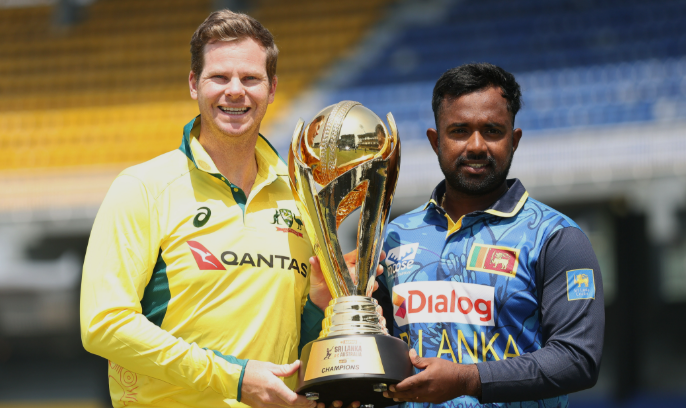
The rivalry between the Sri Lanka national cricket team and the Australia national cricket team has evolved from one sided contests into a story of resilience, adaptation, and occasional brilliance. In the early years, Australia dominated with pace, discipline, and ruthless consistency, while Sri Lanka struggled to find stability at the highest level. Over time, however, Sri Lanka developed a fearless batting approach and world class spin attack that began to challenge Australia in key moments. From Test battles to ICC tournament clashes, this rivalry has produced iconic performances, shifting momentum, and unforgettable cricketing drama that reflects two very different cricketing cultures colliding across decades.
Head-to-Head Summary Teams
Format
Total Matches
Australia Wins
Sri Lanka Wins
Draws / No Result
Test
33
21
4
8
ODI
105
63
38
4
T20I
27
15
11
1
Total
165
99
53
13
ICC Men’s Team Rankings
Team
Test Rank
ODI Rank
T20I Rank
Australia
#1
#3
#3
Sri Lanka
#7
#4
#8
Test Stats
Metric
Australian Men’s Team
Sri Lanka National Team
Matches Won
21
4
Home Wins
13
4
Away Wins
8
0
Highest Team Total
654/6d
547/8d
Lowest Team Total
106
97
ODI Stats
Metric
Australian Men’s Team
Sri Lanka National Team
Matches Won
63
38
Home Wins
39
14
Away Wins
13
16
Highest Team Total
376/9
343/5
Lowest Team Total
74
91
Highest Individual Score
David Warner
Pathum Nissanka
Best Bowling Figures
Mitchell Johnson
Nuwan Kulasekara
T20 Stats
Metric
Australian Men’s Team
Sri Lanka National Team
Matches Won
15
11
Home Wins
8
5
Away Wins
5
2
Neutral Venue Wins
2
4
Highest Team Total
233/2
198/3
Lowest Team Total
133
87
Early Encounters and First Signs of Rivalry
The early meetings between the Sri Lanka national cricket team and the Australia national cricket team in the 1980s and early 1990s were heavily one sided in Australia’s favor. Australia entered this era as a dominant force with a well structured pace attack and disciplined batting order, while Sri Lanka was still finding its identity in international cricket. Matches were often decided within the first innings itself, especially in Test cricket where Australian seamers exploited conditions with precision. However, Sri Lanka showed early signs of talent through players like Arjuna Ranatunga and Aravinda de Silva, who occasionally resisted pressure. These early contests laid the foundation for a rivalry built on learning, adaptation, and gradual improvement rather than equal competition.
Score
Winning
Performance
Season
Useful Info
AUS 1-0 SL
Australia
Dominant bowling control
1985-86
Early Test meeting
AUS 2-0 SL
Australia
Top order batting strength
1989-90
Australia pace dominance
AUS 3-0 SL
Australia
Complete team control
1992
Sri Lanka struggle overseas
AUS 1-0 SL ODI
Australia
Limited overs pressure play
Early 1990s
Sri Lanka batting growth phase
Australia’s Era of Control and Sri Lanka’s Learning Phase
During the late 1990s and early 2000s, Australia asserted near total dominance in world cricket, and Sri Lanka faced the toughest phase of this rivalry. The Australian side, led by players like Ricky Ponting and Steve Waugh, combined aggressive batting depth with relentless bowling consistency. Sri Lanka struggled especially in overseas conditions where bounce and pace exposed technical weaknesses. Despite this, Sri Lanka slowly adapted through exposure to high pressure matches, improving their middle order stability and spin strategy. Players like Muttiah Muralitharan began to emerge as key threats, but Australia’s ability to counter spin and accelerate scoring made them a step ahead in most encounters.
Score
Winning
Performance
Season
Useful Info
AUS 2-0 SL
Australia
Strong batting depth
1998
Australia peak era
AUS 3-0 SL
Australia
Fast bowling dominance
2001
Away series control
AUS 2-1 SL
Australia
Spin handling improvement
2003
Competitive ODI series
AUS 4-0 SL
Australia
Complete tactical superiority
2004
One sided Test dominance
1996 World Cup Shift and Sri Lanka’s Rise in Confidence
The 1996 World Cup became a turning point for the Sri Lanka national cricket team, changing how they approached elite teams like the Australia national cricket team. Sri Lanka’s aggressive batting at the top, led by Sanath Jayasuriya and Romesh Kaluwitharana, introduced a fearless approach that unsettled even the best bowling attacks. While Australia still maintained superiority in bilateral series, Sri Lanka’s confidence improved significantly. They began targeting fast bowlers early in the innings and using spin more aggressively in home conditions. The psychological shift was more important than the results, as Sri Lanka now believed they could challenge top-ranked teams without fear or hesitation.
Score
Winning
Performance
Season
Useful Info
SL 1-0 AUS
Sri Lanka
Aggressive batting revolution
1996 WC
Historic mindset shift
AUS 2-1 SL
Australia
Experience advantage
1997
Competitive ODI series
AUS 3-2 SL
Australia
Close finishes
1999
Rising Sri Lankan challenge
SL 1-1 AUS
Drawn series
Spin impact in home conditions
2000
Balanced tactical contest
Iconic ICC Clashes and Pressure Moments
ICC tournaments brought the most emotionally charged matches between the Sri Lanka national cricket team and the Australia national cricket team. Australia often entered these matches as favorites, but Sri Lanka frequently delivered unexpected resistance. Matches in World Cups and Champions Trophy events highlighted pressure handling, especially from players like Kumar Sangakkara, Mahela Jayawardene, Adam Gilchrist, and Ricky Ponting. Australia’s ability to perform in knockout games remained unmatched for years, but Sri Lanka’s spin attack occasionally disrupted their rhythm. These encounters were defined by momentum shifts, early wickets, and middle overs control, making them some of the most memorable clashes in cricket history.
Score
Winning
Performance
Season
Useful Info
AUS beat SL
Australia
Knockout experience
2003 WC
Australia unbeaten run
AUS beat SL
Australia
Big match temperament
2007 WC
Final stage pressure
AUS beat SL
Australia
Batting dominance
2011 WC
Quarterfinal control
SL beat AUS
Sri Lanka
Spin control win
2014 T20 WC
Rare ICC upset
Test Battles and Spin vs Pace Dynamics
Test cricket between the Sri Lanka national cricket team and the Australia national cricket team has always been defined by contrasting strengths. Australia relied heavily on pace legends like Glenn McGrath and Brett Lee, while Sri Lanka depended on spin mastery led by Muttiah Muralitharan and Chaminda Vaas. In Australia, Sri Lanka often struggled against bounce and seam movement, while in Sri Lanka, spin-friendly conditions created serious challenges for Australian batting. This contrast made Test series tactically rich, with each team dominating in home conditions. Over time, Australia maintained the upper hand, but Sri Lanka earned respect for producing match-winning spells and occasional historic wins at home.
Score
Winning
Performance
Season
Useful Info
AUS 3-0 SL
Australia
Pace attack dominance
2004
Home advantage AUS
SL 1-0 AUS
Sri Lanka
Spin mastery win
2006
Home Test upset
AUS 2-0 SL
Australia
Batting consistency
2009
Controlled series win
AUS 1-1 SL
Drawn
Balanced conditions
2016
Competitive modern era
Conclusion
The rivalry between the Sri Lanka national cricket team and the Australia national cricket team stands as a powerful example of how cricket evolves through eras. While Australia has historically held the upper hand with deeper squads and stronger consistency, Sri Lanka has repeatedly shown that they can challenge even the best on their day. Their spin mastery, aggressive batting phases, and fearless mindset have created memorable upsets and competitive spells. Today, the rivalry is no longer purely one sided but a respected international contest that reflects growth, learning, and the enduring spirit of competitive cricket across generations.