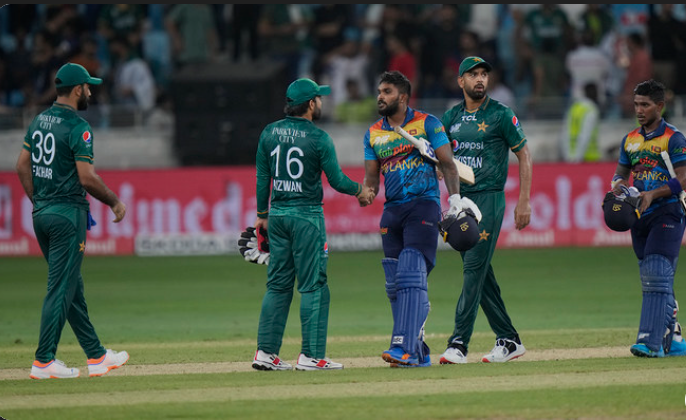
The rivalry between Sri Lanka National Cricket Team and Pakistan National Cricket Team has grown into one of the most layered contests in Asian cricket history. What began as a one-sided affair slowly evolved into a tactical and emotional battle shaped by different eras, playing styles, and generations of stars. From early struggles to Asia Cup thrillers and modern T20 finishes, both teams have repeatedly pushed each other into high-pressure situations. This rivalry is not just about wins and losses but about momentum shifts, iconic performances, and emotional turning points that defined careers and shaped cricketing identity across decades.
ICC Team Rankings
Format
Sri Lanka Ranking
Pakistan Ranking
Test
#6 (86 Rating)
#8 (75 Rating)
ODI
#6 (96 Rating)
#5 (100 Rating)
T20I
#9 (221 Rating)
#6 (240 Rating)
Head-to-Head Summary
Format
Total Matches
Pakistan Wins
Sri Lanka Wins
Draws / No Result
Test
59
23
17
19
ODI
160
96
58
6
T20I
30
18
12
0
Total
249
137
87
25
Test Match Stats
Statistic
Pakistan
Sri Lanka
Matches Played
59
59
Wins
23
17
Highest Team Total
765/6 dec
713/3 dec
Lowest Team Total
90
71
ODI Match Stats
Statistic
Pakistan
Sri Lanka
Matches Played
160
160
Wins
96
58
Highest Team Total
371/9
349/9
Lowest Team Total
75
78
No Result / Tied
4 / 2
4 / 2
T20I Match Stats
Statistic
Pakistan
Sri Lanka
Matches Played
30
30
Wins
18
12
Highest Team Total
212/8
211/3
Lowest Team Total
95
99
Early Sparks of the Rivalry
The first meetings between Sri Lanka National Cricket Team and Pakistan National Cricket Team were shaped by a clear imbalance in experience and confidence. Pakistan entered international cricket earlier with a stronger pace attack, while Sri Lanka were still building their identity in world cricket. Early encounters in the late 1970s and 1980s showed Pakistan’s dominance in both batting depth and bowling aggression. However, Sri Lanka gradually learned to absorb pressure, especially in subcontinental conditions where spin and pitch behavior became equalizers. These early matches were not just about results but about survival, learning, and adaptation. Fans began noticing Sri Lanka’s fighting spirit even in losing causes, setting the foundation for a rivalry that would later become far more competitive and emotionally charged in ICC tournaments and bilateral series.
Season
Matches
Winner
Key Performer
Notable Moment
1980s
6
Pakistan
Imran Khan
Pace dominance
Early 1990s
8
Pakistan
Waqar Younis
Swing bowling impact
Mid 1990s
7
Sri Lanka 2 wins
Aravinda de Silva
First SL breakthroughs
Late 1990s
9
Pakistan
Saeed Anwar
Batting consistency
Building Intensity in Asia Cup Clashes
The Asia Cup became the emotional battlefield for Sri Lanka National Cricket Team and Pakistan National Cricket Team. These matches carried more pressure than bilateral series because both teams often met in knockout-like situations. Sri Lanka found a new level of confidence with their balanced batting lineup, while Pakistan relied on unpredictable brilliance from both batting and bowling units. The intensity increased with every tournament, especially during close finishes where last over drama became common. Players from both sides began treating these matches as personal battles rather than just fixtures. The Asia Cup stage also produced iconic performances that shifted momentum in the rivalry, making it one of the most watched and emotionally charged contests in Asian cricket history.
Season
Matches
Winner
Key Performer
Notable Moment
1995
2
Pakistan
Inzamam-ul-Haq
Match-winning innings
2000
2
Sri Lanka
Sanath Jayasuriya
Explosive starts
2004
2
Sri Lanka
Marvan Atapattu
Final pressure win
2014
2
Pakistan
Shahid Afridi
All-round impact
ODI Battles That Defined the Rivalry Era
One-day internationals became the core of competition between Sri Lanka National Cricket Team and Pakistan National Cricket Team. These matches often reflected contrasting styles. Sri Lanka built innings with stability and spin control, while Pakistan depended on fast scoring bursts and unpredictable bowling spells. ODI scorecards frequently showed momentum swings, with one team collapsing after strong starts. Sri Lanka’s golden generation brought consistency in the late 1990s and early 2000s, while Pakistan answered with explosive batting from top-order players. The rivalry in ODIs also highlighted how conditions influenced outcomes, with UAE pitches favoring Pakistan and Colombo surfaces supporting Sri Lankan spin dominance.
Season
Matches
Winner
Key Performer
Notable Moment
1996-99
10
Sri Lanka
Aravinda de Silva
World Cup form
2000-04
12
Balanced
Jayasuriya
Power hitting era
2005-10
14
Pakistan
Younis Khan
Chase mastery
2011-15
11
Sri Lanka
Malinga
Death bowling control
Pakistan’s Pace Attack vs Sri Lanka’s Batting Resilience
The most defining tactical clash between Sri Lanka National Cricket Team and Pakistan National Cricket Team has always been pace versus patience. Pakistan’s legendary fast bowlers tested Sri Lanka’s top order with swing, reverse swing, and raw pace. In response, Sri Lanka built resilience through disciplined batting and strategic partnerships. Players like Sangakkara and Jayawardene often absorbed pressure before accelerating later in the innings. Pakistan’s bowlers, however, thrived on early breakthroughs, especially in humid conditions where the ball moved sharply. This tactical battle created some of the most gripping sessions in cricket history, where one spell could change the entire match direction within minutes.
Season
Matches
Winner
Key Performer
Notable Moment
1990s
9
Pakistan
Wasim Akram
Swing dominance
2000s
12
Sri Lanka
Sangakkara
Anchoring innings
2010s
10
Pakistan
Shoaib Akhtar
Fastest spells
2020s
6
Balanced
Shaheen Afridi
New generation pace
Sri Lanka’s Spin Strategy Against Pakistan’s Middle Order
Spin bowling has often been Sri Lanka’s biggest weapon against Pakistan National Cricket Team. On turning pitches, Sri Lankan spinners exploited Pakistan’s middle-order vulnerability, especially when early wickets fell. Bowlers like Muttiah Muralitharan controlled run flow and created pressure that forced mistakes. Pakistan’s batters sometimes struggled to rotate strike, leading to dot-ball pressure. However, experienced players occasionally countered spin with aggressive footwork and sweeps. Matches often turned in the middle overs, where spin dominance decided final outcomes. Sri Lanka’s field placements and bowling variations made them particularly strong in home conditions, creating one of the most effective spin-based strategies in modern cricket rivalry history.
Season
Matches
Winner
Key Performer
Notable Moment
1998-2002
8
Sri Lanka
Muralitharan
Spin choke
2003-08
10
Sri Lanka
Jayasuriya
All-round control
2009-14
9
Pakistan
Misbah-ul-Haq
Defensive stability
2015-20
7
Balanced
Yasir Shah
Spin counter
T20 Era Shift Power Hitting vs Tactical Bowling
The T20 era completely transformed the rivalry between Sri Lanka National Cricket Team and Pakistan National Cricket Team. Matches became faster, more aggressive, and heavily dependent on death-over execution. Sri Lanka initially relied on experienced players who focused on control and placement, while Pakistan introduced fearless batting and express pace bowling. The introduction of franchise cricket also influenced player mindset, making strategies more dynamic. T20 matches often ended in final-over thrillers, where a single over could decide the outcome. Pakistan’s bowling attack adapted quickly to pressure situations, while Sri Lanka experimented with younger talent to rebuild dominance in shorter formats.
Season
Matches
Winner
Key Performer
Notable Moment
2009-12
6
Pakistan
Shahid Afridi
Finishing power
2013-16
7
Sri Lanka
Dilshan
Innovative batting
2017-21
8
Pakistan
Babar Azam
Consistent runs
2022-25
5
Balanced
Shaheen Afridi
Death over control
Conclusion
The long journey between Sri Lanka National Cricket Team and Pakistan National Cricket Team reflects how cricket rivalries mature over time. What started with dominance and learning phases has now become a balanced contest filled with tactical depth and unpredictable outcomes. Both teams have produced unforgettable moments, from spin mastery and pace attacks to last-over finishes and tournament-defining performances. The rivalry continues to evolve with new generations stepping in, ensuring that every encounter still carries pressure, pride, and passion. In the end, it remains one of cricket’s most respected and emotionally charged Asian matchups.